
The American legal profession continues to evolve, reflecting broader demographic shifts, new generational trends, and growing awareness of diversity within law firms. The ABA National Lawyer Population Survey and related reports provide a comprehensive snapshot of where the profession stands today – from sheer growth to gender balance, racial representation, and the demand for legal services across the country.
Growth of the Profession
As of January 1, 2024, the United States had 1,322,649 active lawyers. That’s a net increase of more than 41,000 attorneys over the last decade, a growth rate of just over 3%.
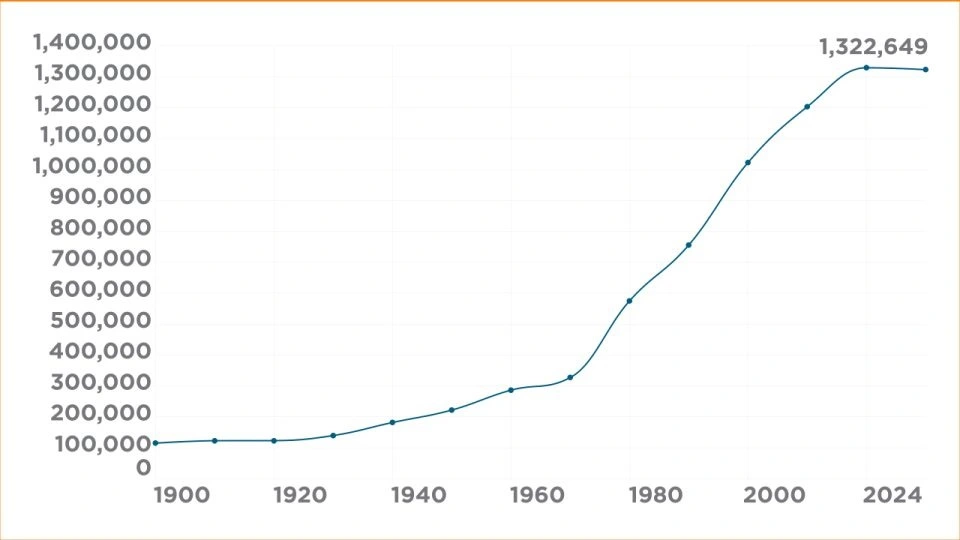
While the numbers have risen over the long term, recent trends show a slowdown. The profession peaked in 2019 at 1.35 million lawyers before dipping slightly in the years that followed. Contrast that with the explosive growth of the 20th century, when the number of lawyers grew nearly eightfold between 1900 and 2000. Today, annual growth is closer to 1%, a stark difference from the boom decades of the 1970s and 1980s.
Where Lawyers Work
According to Apify’s lawyer list, two states dominate the national legal directory: New York (187,656 lawyers) and California (175,883 lawyers). Together, they account for nearly three in every ten U.S. lawyers.
Per capita, New York also leads with almost 10 lawyers for every 1,000 residents, followed by Massachusetts and Connecticut. By contrast, South Carolina sits at the bottom, with just over 2 lawyers per 1,000 residents.
Growth hasn’t been evenly distributed. States like Florida (+17%), Montana, Nebraska, and Texas have seen rapid increases in their lawyer populations over the past decade, while others – including Alabama (-15%), Massachusetts, and Rhode Island – have reported declines.
Gender Representation
Women have steadily gained ground in the profession. In 2014, 36% of lawyers were women; by 2024, that figure reached 41%. While men still make up the majority (58%), the gender gap is shrinking, driven largely by the fact that women now earn the majority of law degrees in the U.S.
This marks a huge shift compared to earlier eras. In 1970, just 3% of all U.S. lawyers were women. By 1980, it was 8%, and by 2000, 27%. The trajectory is clear: each generation is more gender-balanced than the last.
Race and Ethnicity
Diversity within the legal profession has also advanced, though progress remains uneven. In 2014, lawyers of color represented just 12% of the profession. A decade later, that share has nearly doubled to 23%.
- Asian American lawyers saw the largest increase, growing from 2% in 2014 to 7% in 2024.
- Hispanic lawyers rose from 4% to 6%.
- Multiracial lawyers increased from 1% in 2016 to 4% in 2024.
- Black lawyers, however, remained flat at 5% — well below their 13.7% share of the U.S. population.
- Native American and Pacific Islander lawyers continue to make up just 1% of the profession.
Meanwhile, white lawyers dropped from 88% in 2014 to 78% in 2024, though they remain overrepresented compared to the general U.S. population.
Age of Lawyers
Lawyers tend to be older than the average U.S. worker. The median age of an attorney is 46, compared with 42 for all workers. Nearly one in eight lawyers is 65 or older, highlighting the longevity of legal careers.
Younger representation remains limited: only 0.3% of lawyers are under 25, while 13% of the U.S. workforce falls in that age bracket.
Diversity in Law Firms
A historic milestone was reached in 2023 when women became the majority among law firm associates for the first time, making up 50.3% of all associates. This shift reflects decades of steady change, fueled by the fact that women have outnumbered men in U.S. law schools for several years. Still, progress has not been evenly distributed across all levels of the profession. At the partnership level, women remain underrepresented, holding just 28% of partner positions.
Racial and ethnic diversity has also seen gradual improvement over the past three decades. Back in 1991, only 2% of law firm partners were people of color. By 2023, that number had increased to 12%, with Asian American attorneys accounting for the largest share at nearly 5%. Associates are significantly more diverse, with 30% identifying as lawyers of color, suggesting that the profession’s leadership ranks will continue to change as younger cohorts advance in their careers.
Geography plays a significant role in shaping diversity within law firms. In Miami, 28% of all partners are lawyers of color, the highest percentage in the country. By contrast, Pittsburgh sits at the opposite end of the spectrum, with only 2% of its partners coming from underrepresented racial or ethnic groups. California stands out as a leader in law firm diversity, with metro areas such as Los Angeles, San Francisco, and Silicon Valley consistently ranking among the most inclusive in the nation.
The number of openly LGBTQ lawyers has continued to grow steadily within U.S. law firms. In 2013, just over 2% of lawyers identified as LGBTQ; by 2023, that figure had more than doubled to 4.6%. Among associates, representation is even higher at nearly 7%, while summer associates stand out as the most diverse group, with almost 12% identifying as LGBTQ. This younger pipeline of talent suggests that LGBTQ visibility in the profession is likely to increase significantly in the coming years.
Lawyers with disabilities remain a much smaller segment of the profession, though here too progress is evident. In 2023, roughly 2% of law firm lawyers reported having a disability, a figure that has more than doubled in just three years. Associates are slightly more likely than partners to disclose a disability, with 2.4% reporting one compared to 1.4% of partners. While these numbers remain modest overall, the steady rise indicates that awareness and inclusion efforts are beginning to take hold within the profession.
Where Demand is Strongest
Not surprisingly, Washington, D.C. tops the list of metro areas with the highest demand for lawyers, with a location quotient of 3.25 – more than triple the national average. Other hotspots include Tallahassee (2.34), Miami (2.15), New York City (1.99), and Trenton (1.89).
Interestingly, many smaller cities and state capitals rank highly as well, including Santa Fe, New Orleans, and Charleston (WV). On the flip side, regions such as Battle Creek (MI) and Elkhart (IN) report some of the lowest demand.
Final Thoughts
The 2024 profile of the legal profession paints a picture of steady – though uneven – change. Gender representation is steadily balancing, racial and ethnic diversity is improving (albeit slowly), and younger lawyers are reshaping the pipeline. At the same time, the profession remains older, heavily concentrated in a handful of states, and still struggling with equitable representation at the partnership level.
In short: the face of the American lawyer in 2024 is more diverse, more balanced, and more reflective of the country as a whole – but the transformation is far from complete.
Last Updated on October 12, 2026 by Peter